TL;DR
POTS (Plain Old Telephone Service) cannot compete with AI-enhanced cloud communications because it was built to provide basic voice connectivity, while modern businesses need communications systems that improve speed, flexibility, customer experience, employee productivity, and operational visibility. As customer expectations rise and businesses face growing pressure to use AI in service and support, legacy phone lines offer less and less strategic value compared with intelligent cloud platforms.
Table of Contents
- Why Does The POTS vs. Cloud Communications Comparison Matter Now??
- What Is POTS, and What Was It Designed to Do?
- What Are AI-Enhanced Cloud Communications?
- Why Is POTS Too Limited for Modern Business Communication?
- Why Can’t POTS Deliver the AI Capabilities Businesses Now Need?
- Why Does POTS Fall Short on Customer Experience?
- Why Is POTS a Weak Fit for Employee Productivity?
- Why Can’t POTS Scale and Adapt Like Cloud Communications?
- Why Does POTS Offer So Little Visibility Into Communications Performance?
- Why Is POTS Becoming Harder to Justify Strategically?
- POTS Was Built for the Past, Not the Future
- It’s Time to Move Beyond Legacy Phone Lines
- Frequently Asked Questions
Why Does the POTS vs. Cloud Communications Comparison Matter Now?
For many years, POTS was the standard for business calling. It gave organizations a dependable way to make and receive calls, connect offices, and maintain essential communications. For its time, that was enough. Businesses mainly needed dial tone, call reliability, and familiar hardware. But that definition of “enough” has changed.
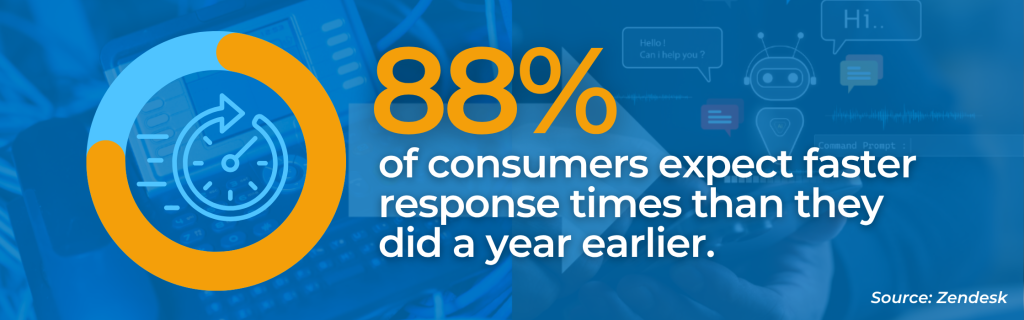
Business communications are no longer judged only by whether calls connect. They are judged by how fast a business responds, how intelligently calls are routed, how easily teams can work from anywhere, how well customer interactions are handled, and how much insight leaders can get from those conversations. The communications platform is no longer just infrastructure. It increasingly shapes customer experience, employee efficiency, and operational performance. At the same time, customer expectations are climbing. According to Zendesk, 74% of consumers now expect customer service to be available 24/7, and 88% expect faster response times than they did a year earlier.
That is why the question is no longer whether POTS still works. In many cases, it still does what it was designed to do. The real question is whether it can compete with communications technology that is built to be intelligent, flexible, connected, and increasingly AI-driven. The answer is no.
What Is POTS, and What Was It Designed to Do?
POTS stands for Plain Old Telephone Service. It refers to traditional analog phone service delivered through legacy telephone infrastructure. It was designed for straightforward voice calling: place a call, receive a call, transfer a call, maintain a line. For decades, that model served businesses well because communications needs were simpler and technology expectations were lower.
The strength of POTS was its simplicity. It was familiar, widely available, and built around a narrow but important function. But that narrow design is also the reason it cannot compete today. POTS was never built to support software-driven workflows, mobile workforces, omnichannel engagement, automation, analytics, AI-assisted call handling, or integration with business systems like CRM platforms and calendars. It is a legacy connectivity tool, not a modern communications platform.
That distinction matters because businesses now need much more from every customer and employee interaction. A system that only connects calls cannot compete well against one that can also understand intent, route intelligently, summarize conversations, automate routine tasks, and provide insight into what is happening across the organization.
What Are AI-Enhanced Cloud Communications?
AI-enhanced cloud communications refer to modern business communications platforms delivered through the cloud and improved by artificial intelligence. These platforms typically combine voice, messaging, meetings, collaboration, and often contact center capabilities into one connected environment. Rather than depending on fixed analog infrastructure, they are software-based, easier to update, and far more adaptable.
The “AI-enhanced” part is what changes the equation. Instead of simply passing a call from point A to point B, AI-enabled systems can help answer calls, determine caller intent, route interactions more accurately, assist employees in real time, generate call or meeting summaries, automate follow-up tasks, and provide analytics that help organizations improve service and efficiency. Gartner reported in February 2026 that 91% of customer service and support leaders are under pressure from executive leadership to implement AI, showing how quickly AI has moved from experimental to expected in service environments.
In other words, cloud communications are not just a replacement for old phone lines. They are a different category of business technology. They turn communications into an active business asset rather than a passive utility.
Why Is POTS Too Limited for Modern Business Communication?
POTS is too limited for modern business communication because it only provides basic voice connectivity, while modern organizations need communications systems that help them operate faster and smarter.
A traditional analog line can ring a desk phone. It can connect a caller to an employee. It can support a basic phone tree with external hardware or service layers. But it does not improve the communication itself. It does not help a business reduce friction, shorten response times, or create more consistent customer experiences. It does not support modern expectations around mobility, intelligent routing, integrated messaging, or flexible administration.
That limitation becomes more serious as communications become more central to business performance. Today, a business phone system is often expected to support hybrid work, multiple locations, customer service workflows, sales responsiveness, appointment handling, escalation paths, and cross-team collaboration. POTS was not designed for any of that. It was designed for calling, not communications strategy.
Why Can’t POTS Deliver the AI Capabilities Businesses Now Need?
POTS cannot deliver the AI capabilities businesses now need because it has no native intelligence layer. It was built for analog transmission, not software-driven decision-making.
That means no AI receptionist to answer every call around the clock. No intelligent routing based on what the caller says or needs. No automatic summaries after calls. No transcription-based search. No AI support for agents or employees during conversations. No automation for repetitive front-end communications tasks. No natural way to connect voice interactions to digital workflows.
This matters because AI is increasingly becoming part of the communications baseline. Zendesk’s 2026 customer service statistics page says nearly 7 in 10 consumers believe that more natural-sounding AI via phone would enhance their experience, and 60% want companies to adopt advanced Voice AI technologies.
That does not mean businesses should remove people from every interaction. It means communications systems are now expected to blend responsiveness, automation, and human support more effectively. POTS cannot do that because it cannot evolve into an AI-enabled system. It can only remain what it already is: a basic phone line.
Why Does POTS Fall Short on Customer Experience?
POTS falls short on customer experience because it cannot support the speed, consistency, and intelligence that customers increasingly expect.
When businesses rely on legacy calling environments, customers are more likely to encounter slower manual routing, longer hold times, missed calls, limited after-hours coverage, and less personalized service. A caller may reach the wrong person. A message may sit unanswered. A business may have no efficient way to provide immediate front-line response without adding staff or complexity.
By contrast, AI-enhanced cloud communications can help businesses answer more quickly, route more accurately, and provide a better front-door experience. That may include always-on call answering, more precise transfers, better continuity between interactions, and easier integration with business tools that give employees context. Zendesk’s CX Trends 2026 findings reinforce why that matters: customers increasingly expect 24/7 availability and faster responses, which raises the standard for every business interaction.
Customer experience is no longer shaped only by what happens when a live employee picks up the phone. It is shaped by the entire path to resolution. POTS gives businesses very little ability to optimize that path.
Why Is POTS a Weak Fit for Employee Productivity?
POTS is a weak fit for employee productivity because it gives employees a line to answer, but not the tools to work more efficiently around that interaction.
Modern employees often need to work across devices, locations, and applications. They may need to move between office and remote environments, coordinate with teammates through messaging and meetings, access communications on mobile devices, or review the details of prior conversations without relying on handwritten notes or memory. They also benefit from AI tools that reduce repetitive administrative work after conversations.
AI-enhanced cloud platforms can help by summarizing calls, capturing action items, routing calls more effectively before they ever reach an employee, and integrating communications into broader workflows. McKinsey noted that AI-driven solutions can already solve simple transactional issues through virtual voice and chat assistants and are transforming customer care by shifting some volume from live channels to virtual assistants.
That shift does not just affect customers. It affects employees too. When routine inquiries are handled more efficiently and conversation data is easier to capture and act on, teams can focus more time on higher-value work. POTS offers no meaningful support for that kind of productivity improvement.
Why Can’t POTS Scale and Adapt Like Cloud Communications?
POTS cannot scale and adapt like cloud communications because it is tied to older infrastructure models and rigid deployment assumptions.
When businesses grow, open locations, support more remote employees, or change how teams communicate, they need systems that can adjust quickly. Cloud platforms are built for that. Administrators can usually add users, change call flows, roll out new features, support distributed teams, and extend service across locations with far less friction than traditional analog environments.
POTS is the opposite. Expansion tends to be more cumbersome, change is slower, and the system is less suited to business environments that evolve quickly. It is difficult for a legacy analog model to keep pace with organizations that want communications to be agile, software-driven, and easy to update.
That flexibility matters even more in an AI era because AI capabilities continue to improve. Businesses that move to cloud platforms position themselves to take advantage of new features and workflows over time. Businesses that remain tied to POTS are largely locked into the past.
Why Does POTS Offer So Little Visibility Into Communications Performance?
POTS offers little visibility into communications performance because it was not designed to generate operational insight. It handles calls, but it does not tell leaders much about what those calls mean.
Businesses today want to know how many calls are being missed, when call volume spikes, where bottlenecks happen, how quickly interactions are handled, what customers are asking about, how employees are performing, and where automation can improve service. AI-enhanced cloud communications can help answer those questions through dashboards, reporting, transcription, trend analysis, and conversation intelligence.
POTS generally cannot. It does not naturally create usable data from voice interactions. That leaves businesses with limited visibility into one of their most important customer-facing and employee-facing channels. A communications model that cannot support measurement and continuous improvement will only become harder to justify.
Why Is POTS Becoming Harder to Justify Strategically?
POTS is becoming harder to justify strategically because it delivers less business value relative to what modern platforms can provide.
In the past, businesses could justify a traditional line because dependable connectivity was the main requirement. Today, leaders are asking more from communications investments. They want systems that improve customer experience, support employees, reduce manual work, create better visibility, and help the organization stay competitive. They also face growing pressure to adopt AI where it can improve service operations. Gartner’s February 2026 survey revealed that 91% of service and support leaders are under executive pressure to implement AI reflects that broader shift in expectations.
That does not mean every business must implement every AI feature at once. It does mean the market has moved. The standard is no longer “can we make and receive calls?” The standard is closer to “can our communications environment help us serve customers better, operate more efficiently, and adapt to what comes next?” POTS cannot meet that standard because it was never built for it.
POTS Was Built for the Past, Not the Future
POTS is not failing because it stopped being what it always was. It is failing because business communications have become something much bigger than basic voice service.
Modern organizations need more than dial tone. They need faster response times, smarter call handling, better support for employees, stronger customer experiences, greater flexibility, and better insight into communications performance. AI-enhanced cloud communications are designed for that environment. POTS is not.
That is why POTS cannot truly compete. It is a legacy tool in a market that increasingly rewards intelligence, adaptability, and connected experiences. Businesses are no longer choosing between two versions of phone service. They are choosing between maintaining legacy connectivity and upgrading to a communications platform that can actively improve how the business runs.
It’s Time To Move Beyond Legacy Phone Lines
If your business is still relying on legacy phone infrastructure, now is the time to look at what modern cloud communications can do instead.
Crexendo® VIP™ helps businesses move beyond basic calling with an all-in-one cloud communications platform that includes voice, messaging, meetings, mobility, and collaboration. With AI-powered capabilities like our CAIRO AI Receptionist and Orchestrator, intelligent call routing, AI call summaries, and AI meeting summaries, organizations can modernize communications while improving customer experience and team productivity.
Schedule a demo to see how Crexendo® VIP™ can help your business replace outdated legacy phone lines with smarter, AI-enhanced cloud communications.
Frequently Asked Questions
What is POTS in business communications?
POTS stands for Plain Old Telephone Service. It is the traditional analog phone service model built for basic voice calling.
Why can’t POTS compete with AI-enhanced cloud communications?
Because POTS only provides basic connectivity, while AI-enhanced cloud communications provide intelligence, automation, analytics, flexibility, and better support for customer and employee experiences.
Are businesses really expected to use AI in communications now?
Yes. Gartner reported in February 2026 that 91% of customer service and support leaders are under pressure from executive leadership to implement AI.
Do customers actually want AI in phone interactions?
Increasingly, yes. Zendesk reported that nearly 7 in 10 consumers believe more natural-sounding AI via phone would improve their experience, and 60% want companies to adopt advanced Voice AI technologies.
Is cloud communications only for large enterprises?
No. Small and midsize businesses often benefit significantly because cloud platforms are easier to scale, manage, and modernize than legacy systems.
What should businesses look for in a POTS replacement?
They should look for a cloud communications platform with voice, mobility, messaging, analytics, integrations, and AI capabilities such as intelligent routing, automated summaries, and AI receptionist functionality.