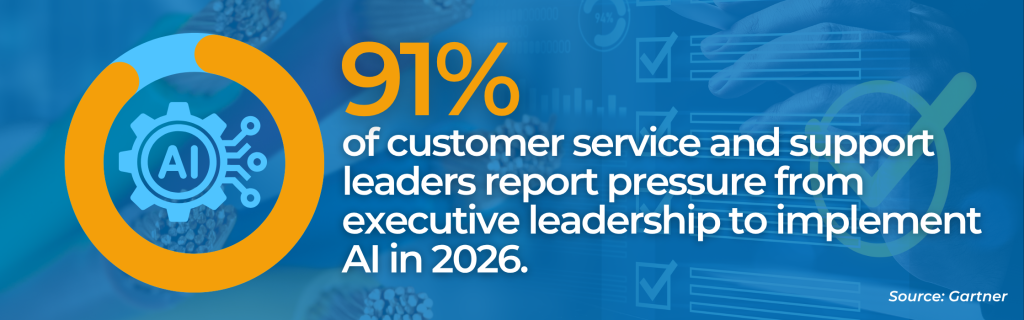
TL;DR: Enterprise buyers no longer ask whether a cloud communications platform has AI, they ask how deeply it’s built in across employee and customer workflows. This shift is collapsing the old lines between UCaaS, contact center software, and communications APIs. Gartner reports 91% of customer service leaders now feel executive pressure to implement AI in 2026, and platforms that treat AI as core infrastructure are pulling ahead of those that bolt it on.
In this article:
- Why is AI becoming a core requirement in cloud communications?
- What’s driving the convergence of UCaaS and CCaaS?
- What AI capabilities are buyers prioritizing?
- What architecture supports AI-ready communications?
- What should IT leaders look for in an AI-ready platform?
Cloud communications is going through a real shift. AI integration in cloud communications has moved from a nice-to-have feature to a baseline requirement for enterprise buyers. Across industries, IT leaders no longer ask whether a platform supports AI. They ask how deeply that AI reaches into both employee collaboration and customer-facing workflows.
This change is rewriting vendor roadmaps and procurement checklists. Organizations that spent years migrating from legacy PBX systems to cloud-based unified communications as a service (UCaaS) now face a second wave of change. This one isn’t driven by infrastructure costs. It’s driven by competitive pressure to automate, personalize, and speed up every customer interaction.
Why Is AI Becoming a Core Requirement in Cloud Communications?
AI is no longer a differentiator buyers weigh as a bonus feature. It’s a baseline expectation built into how they evaluate every vendor.
Executive leadership is pushing this shift from the top down. According to a February 2026 Gartner survey of customer service and support leaders, 91% report pressure from executive leadership to implement AI in 2026. That pressure runs from the contact center to internal collaboration tools alike.
AI has moved from an experimental add-on to a baseline requirement for enterprise communications buyers.
For years, UCaaS competed on uptime, integrations, and per-seat pricing. Those factors still matter, but they no longer decide deals on their own. As core features like voice, video, and messaging have matured and become commoditized, differentiation has shifted to the intelligence layered on top of the communications stack.
What’s Driving the Convergence of UCaaS and CCaaS?
Buyers increasingly want one AI backbone across communications, not two disconnected systems.
Procurement teams once evaluated unified communications and contact center software (CCaaS) as separate purchases with separate RFPs. That approach is fading. Enterprises now seek vendors who can deliver both on a shared AI foundation.
The lines between UCaaS and CCaaS are converging around a single, shared AI foundation.
The logic is practical: an AI model trained on customer interaction data should also help internal support teams, not just external callers. Splitting these systems creates data silos and adds integration overhead that slows every workflow down. This is the same logic behind how AI can help elevate customer experience across every touchpoint, since a unified AI layer requires unified infrastructure underneath it.
Enterprises want AI that can categorize and prioritize inbound communications automatically. They also want it to surface relevant knowledge-base content to agents in real time and escalate complex issues to specialists while it handles routine volume on its own.
This convergence also simplifies procurement. Instead of managing separate contracts, support teams, and update cycles for each system, IT leaders can evaluate one vendor relationship built around a shared set of AI capabilities.
What AI Capabilities Are Buyers Prioritizing?
Buyers want AI built natively into the platform, not added through third-party integrations that introduce latency and cost.
Feature requests point to real-time transcription, sentiment analysis, and AI agents that handle scheduling, troubleshooting, and routine inquiries without a human agent. This demand isn’t limited to contact centers. Internal collaboration tools now need AI that summarizes meetings, surfaces action items, and routes requests to the right team automatically.
Buyers increasingly reject bolted-on AI integrations in favor of capabilities built directly into the platform.
How organizations measure success has changed too. Traditional UCaaS business cases centered on hard savings: decommissioning on-premises equipment and cutting telecom spend. AI-enhanced platforms get evaluated on different metrics, including average handle time, first-call resolution, and customer satisfaction scores. Moving agents from repetitive tasks to higher-value work is becoming a primary reason enterprises choose one platform over another.
What Architecture Supports AI-Ready Communications?
AI-ready communications depend on a mature technical foundation, not a single new feature.
Session Initiation Protocol (SIP) remains the core standard for setting up voice and video sessions. PSTN connectivity — a fundamental UCaaS capability, per Gartner — still lets cloud platforms reach external callers for inbound and outbound calls. What’s changed is the intelligence layer sitting on top of that foundation.
AI agents need fast access to conversation transcripts, metadata, and customer history to work well, not just a voice connection.
That requirement demands tight integration between the communications layer and the data platforms behind it. Vendors are approaching this differently. Some build pre-packaged AI agents for common use cases. Others open APIs so enterprises can build custom automation on top of CPaaS foundations. Either approach only works if the underlying architecture supports low-latency data access at scale.
What Should IT Leaders Look for When Evaluating AI-Ready Platforms?
The strongest platforms treat AI as infrastructure, not as a feature added to a single department.
Enterprises that pilot AI in one team or one use case tend to stall out. Those that build their communications strategy around AI from the start, with voice, video, messaging, and customer data flowing into one model, gain an advantage in speed, cost, and customer experience that compounds over time.
Platforms that treat AI as core infrastructure outperform those that treat it as an add-on feature.
When evaluating vendors, IT leaders should ask how deeply AI reaches across both employee and customer workflows, whether the platform unifies UCaaS ad CCaaS on shared data, and whether AI capabilities are native or dependent on third-party add-ons. Crexendo’s AI-powered communications platform reflects the shift to integrated AI capabilities, building AI into the core service rather than adding it as a separate module. As the boundaries between these categories continue to blur, the platforms built around AI from the ground up will be the ones enterprises can scale with.
Ready to see AI-powered communications in action?
Discover how Crexendo VIP’s advanced AI capabilities can help your organization, schedule a demo today!
Frequently Asked Questions
It means AI capabilities, such as transcription, sentiment analysis, and automated agents, are built directly into the communications platform. Rather than adding AI through a separate tool, the platform applies it natively across calls, messaging, and customer interactions in one system.
AI is quickly becoming a baseline expectation, not a premium add-on. Gartner reports 91% of customer service leaders feel executive pressure to implement AI in 2026, which is pushing vendors to build AI into core features rather than offer it as an optional upgrade.
AI now handles routine inquiries, surfaces relevant knowledge-base content to agents in real time, and flags complex issues for human specialists to resolve. This reduces average handle time and lets contact centers redeploy agents from repetitive tasks to higher-value customer interactions.
UCaaS covers internal collaboration, CCaaS covers customer service and support, and CPaaS provides programmable communications APIs for custom automation. When AI is shared across all three, one intelligence layer supports employees and customers instead of running as three separate, disconnected systems.
Look for AI built natively into the platform rather than bolted on through third-party integrations. Ask whether the vendor unifies UCaaS, CCaaS, and CPaaS on shared data, and confirm their architecture supports low-latency access to customer history, context, and conversation transcripts.
Yes, but the savings often show up in different metrics than legacy UCaaS did. Instead of only counting telecom savings, enterprises now measure gains in average handle time, first-call resolution, customer satisfaction, and agent capacity freed up for higher-value work.