TL;DR: Businesses should be using AI in their voice communications now for three simple reasons: customers expect faster and smarter experiences, employees need better tools to serve customers efficiently, and competitors are already using AI to improve speed, service, and operational performance. AI is no longer just a future-looking enhancement. It is becoming a practical business necessity in voice communications today.
Why is AI becoming so important in voice communications right now?
AI is becoming important in voice communications right now because the expectations around business communication have changed. Voice is no longer just about answering calls, placing callers on hold, and routing them to the right extension. Today, customers expect fast responses, employees need better ways to manage communication workloads, and businesses need to find new ways to stay efficient and competitive.
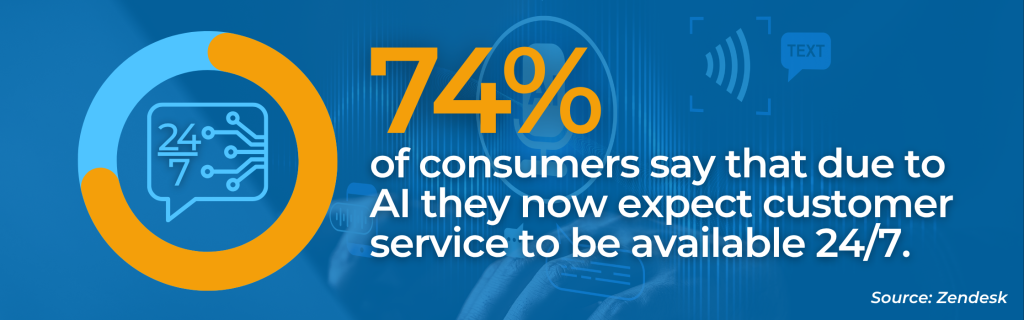
For many organizations, voice remains one of the most important channels for sales conversations, customer service, appointment scheduling, issue resolution, and internal collaboration. According to Zendesk, 74% of consumers say that due to AI they now expect customer service to be available 24/7. When voice interactions are slow, inconsistent, or difficult to manage, the business feels it quickly. Customer frustration rises. Employee productivity suffers. Opportunities are missed.
AI helps businesses modernize voice communications by making conversations faster, workflows smarter, and communication processes more scalable. Instead of treating voice as a basic utility, organizations can use AI to turn it into a stronger part of the customer experience and a more efficient part of day-to-day operations.
What has changed about business voice communications?
Business voice communications have changed because they are now expected to deliver speed, convenience, and intelligence, not just connection. A phone call used to be seen as a simple interaction between a caller and an employee. Now, businesses are expected to deliver more. Callers want less waiting, fewer transfers, better answers, and faster resolution. Teams want tools that reduce manual work and make follow-up easier. Leaders want communication systems that support growth without creating unnecessary complexity.
That shift is exactly why AI is gaining ground in voice communications. It helps businesses adapt to a world where responsiveness matters more, operational efficiency matters more, and customer expectations are higher than ever.
What are the top 3 reasons businesses should be using AI in their voice communications now?
The three biggest reasons businesses should be using AI in their voice communications now are customer expectations, employee enablement, and competitive pressure. These are not abstract technology trends. They are practical business realities shaping how organizations need to communicate today.
Let’s look at each one.
1. Customer Expectations
Why do customer expectations make AI in voice communications necessary?
Customer expectations make AI in voice communications necessary because people now expect business interactions to be faster, easier, and more responsive. Customers are no longer comparing one business only to another business in the same category. They are comparing every experience to the best and fastest interactions they have elsewhere.
That matters for voice communications because phone calls still tend to happen when something is important. A customer calls when they need help, need an answer, want to schedule something, need to speak with a real person, or want to solve a problem quickly. In those moments, speed and convenience matter a great deal.
If a business makes callers wait too long, transfers them repeatedly, misses calls after hours, or forces them through inefficient processes, that experience feels outdated. It creates friction at exactly the moment when the customer is seeking clarity and support.
AI helps reduce that friction. It can support faster call handling, more intelligent routing, better availability, and smoother communication experiences. That is increasingly what customers expect.
Why are customers expecting better voice experiences from businesses?
Customers are expecting better voice experiences because they are already used to interacting with AI in other areas of life. People use AI-powered tools every day, whether they realize it or not. They encounter smart assistants, automated support experiences, recommendation engines, intelligent search tools, and self-service systems across digital and service environments.
Because of that, expectations have shifted. Customers are more comfortable with AI-assisted experiences than they were just a few years ago. They are used to getting information quickly, completing tasks with less effort, and receiving responses outside of traditional business hours.
When they call a business, they bring those expectations with them. They want the process to feel efficient. They want the business to respond quickly. They want less waiting and less friction. They want voice interactions to feel like part of a modern customer experience, not a bottleneck inside it.
Why does familiarity with AI matter when customers call a business?
Familiarity with AI matters because it changes what customers consider acceptable service. Customers do not necessarily care whether a business uses AI for the sake of using AI. What they care about is whether the experience is fast, convenient, and effective.
If AI can help a business answer more quickly, route calls more accurately, capture details better, or improve follow-up, customers benefit. And once customers experience that kind of responsiveness elsewhere, they begin to expect it more broadly.
That does not mean every customer wants a fully automated experience. It means customers want businesses to remove unnecessary friction. AI can help do that by supporting the front end of voice communication, assisting with call handling, and making the overall experience more streamlined.
Why does AI help businesses meet modern customer expectations?
AI helps businesses meet modern customer expectations by making voice interactions more immediate, more intelligent, and more consistent. For example, AI can help ensure calls are answered more promptly, direct callers to the right destination faster, provide support outside standard hours, and reduce the communication gaps that often frustrate customers.
This matters because the customer experience is not shaped only by what a business says. It is also shaped by how quickly the business responds, how easily the customer gets help, and how smooth the process feels from beginning to end.
AI supports better voice experiences by helping businesses operate with greater speed and consistency. That creates a better impression, reduces missed opportunities, and helps organizations serve more customers without sacrificing responsiveness.
Why does a faster voice experience matter to the customer experience?
A faster voice experience matters because speed has become a core part of customer satisfaction. A customer may forgive a minor delay once in a while, but when slow responses become the norm, frustration builds quickly. Long hold times, repeated explanations, missed calls, and delayed follow-up all send the same message: this business is hard to deal with.
That is why faster voice communications are so valuable. When customers get answers quickly, reach the right destination sooner, and feel that their time is being respected, the entire interaction improves. AI can help businesses create those outcomes more consistently.
In other words, customers are not simply looking for someone to answer the phone. They are looking for a better and faster experience. AI helps businesses deliver it.
2. Employee Enablement
Why do employees need AI tools in voice communications?
Employees need AI tools in voice communications because they are under growing pressure to respond faster, manage more interactions, and deliver better service without wasting time on repetitive work. In many organizations, customer-facing employees are balancing calls, emails, meetings, notes, scheduling, and follow-up tasks all at once.
That workload creates friction inside the business. Valuable time is spent on administrative tasks. Important details can be missed. Follow-up may slow down. Customers may wait longer for answers. Employees may feel like they are constantly reacting instead of working efficiently.
AI helps by reducing that burden. It can assist with routine communication tasks and support faster access to information. That does not replace employees. It helps them perform better.
Why do employees need more support in customer-facing communication?
Employees need more support because customer-facing communication is often fast-moving, repetitive, and operationally demanding. A single employee may need to answer questions, route callers, take notes, document outcomes, coordinate next steps, and move between systems during the same workday.
Without strong tools, those responsibilities stack up quickly. Employees lose time to manual work that does not add much value to the customer interaction itself. That makes it harder to stay responsive and consistent, especially when call volume increases or resources are limited.
Organizations that want to improve the customer experience should pay close attention to the employee experience behind it. If employees are overloaded with manual communication tasks, the business will feel it in slower service, missed details, and inconsistent outcomes.
Why does AI help employees serve customers better and faster?
AI helps employees serve customers better and faster by removing unnecessary manual work and making communication workflows more efficient. For example, AI can help summarize calls, summarize meetings, support faster note capture, and reduce the time employees spend documenting conversations.
That matters because every minute spent on repetitive administrative work is a minute not spent helping a customer, solving an issue, or moving a conversation forward. AI gives employees more time to focus on those higher-value tasks.
It also helps improve consistency. When key details are captured more reliably and communication workflows move faster, teams are better positioned to follow up accurately and respond with confidence.
Why is AI useful for everyday communication workflows?
AI is useful for everyday communication workflows because it can simplify the tasks that tend to slow teams down. Voice communications do not end when the call ends. Someone often needs to document what happened, share updates, schedule follow-up, or align with other team members. The same is true for meetings. Important information needs to be captured and turned into action.
AI can support that process by creating summaries, helping surface next steps, and making post-conversation work faster and easier. This is one of the most practical ways AI adds value. It helps employees spend less time recreating what happened and more time acting on it.
In a busy business environment, that can make a real difference. Faster documentation leads to faster follow-up. Better summaries lead to better continuity. Less administrative work leads to more productive teams.
Why does helping employees matter to overall business performance?
Helping employees matters because employee effectiveness directly shapes customer experience, productivity, and business efficiency. When teams are better equipped, they can respond faster, handle more interactions, and provide more consistent service. That improves customer outcomes and helps the organization operate more smoothly.
Too often, businesses think about AI only in terms of automation. But one of its biggest benefits is enablement. AI can help people do their jobs better. It can reduce low-value work, improve communication continuity, and give employees tools that support stronger performance.
When employees can move faster and work more effectively, the business becomes more responsive as a whole. That is why AI in voice communications is not only a technology story. It is also an operations and workforce story.
3. Competitive Pressure
Why are competitors a reason businesses should adopt AI now?
Competitors are a reason businesses should adopt AI now because many organizations are already using AI to improve responsiveness, scale communication more efficiently, and strengthen customer experience. In competitive markets, businesses are always looking for ways to respond faster, serve better, and operate more efficiently. AI helps them do all three.
That means AI is changing the standard customers compare businesses against. If one company uses AI to answer faster, route more intelligently, reduce delays, and improve follow-up, other companies begin to look slower or less efficient by comparison.
Businesses do not need to chase trends for the sake of appearing innovative. But they do need to pay attention when new capabilities begin to reshape expectations and create measurable competitive advantages. AI in voice communications is reaching that point.
Why does competitor adoption make AI more urgent?
Competitor adoption makes AI more urgent because it increases the risk of falling behind on service quality and speed. If other businesses in your category are already using AI to improve call handling and communication workflows, they may be creating better experiences at lower operational cost.
That can affect everything from customer satisfaction to conversion rates to retention. Even if a prospective customer never asks what technology is behind the experience, they will notice whether one business is easier to reach, faster to respond, and more efficient to work with.
The urgency comes from the fact that AI is no longer just experimental. It is being applied in practical ways that matter to day-to-day business performance. The longer businesses wait, the greater the chance they will be forced to catch up instead of using AI to lead.
Why is AI becoming a competitive advantage in voice communications?
AI is becoming a competitive advantage because it helps businesses improve the quality and scalability of communication without increasing complexity at the same pace. A company that can answer calls more intelligently, summarize conversations automatically, support employees with better tools, and reduce delays across communication workflows has a real operational edge.
That edge can show up in many ways. It may show up in faster service. It may show up in stronger customer impressions. It may show up in better team productivity. It may show up in a business being able to handle growth more effectively.
Competitive advantage does not always come from one dramatic change. Often, it comes from a series of improvements that make a business more responsive, more efficient, and easier to work with. AI supports exactly those kinds of improvements.
Why is waiting to adopt AI a risk?
Waiting to adopt AI is a risk because businesses that delay may lose ground in customer experience, operational efficiency, and market perception. When an important capability becomes easier to adopt and more relevant to business performance, delay becomes more costly.
A business that postpones AI adoption may continue relying on slower manual processes while competitors streamline theirs. It may ask employees to carry unnecessary communication burdens while others reduce them. It may deliver an experience that feels less responsive while customers increasingly value speed and convenience.
That does not mean every business needs to implement every AI tool immediately. It does mean businesses should evaluate where AI can make the biggest impact and begin moving in that direction. In voice communications, that opportunity is already here.
Why should businesses think about AI as a competitive necessity instead of an optional feature?
Businesses should think about AI as a competitive necessity because it is becoming part of the expected communications environment rather than a nice-to-have extra. Customers expect speed. Employees need better support. Competitors are moving. Those forces together make AI more than an optional innovation project.
In many cases, AI is now part of building a communications strategy that is modern, scalable, and aligned with how businesses need to operate. Organizations that treat AI as a side experiment may miss its larger value. It can strengthen the entire communication experience, from the first incoming call to the follow-up that happens after a meeting ends.
Key Takeaways
Why is AI in voice communications no longer optional for many businesses?
AI in voice communications is no longer optional for many businesses because it directly supports the areas that matter most: customer experience, employee productivity, and competitive strength. When a technology helps improve all three, it quickly becomes strategically important.
This is especially true for organizations that rely heavily on inbound calls, appointment scheduling, service coordination, high-value conversations, or fast customer response. In those environments, even small communication improvements can create meaningful business value.
AI is not valuable just because it is new. It is valuable because it helps solve real problems in a channel that still matters deeply. That is why more businesses are taking it seriously now.
Why should businesses act now instead of later?
Businesses should act now because the practical benefits of AI in voice communications are already available today. This is not a wait-and-see category anymore. Businesses can use AI now to improve front-line call handling, reduce missed opportunities, support employees, and create more efficient communication workflows.
The earlier a business begins, the sooner it can learn what works best in its environment. It can identify high-impact use cases, build internal confidence, and create measurable improvements before competitors widen the gap.
Acting now also helps businesses be proactive rather than reactive. Instead of waiting for communication inefficiencies to become more painful or competitive pressure to become more visible, they can start improving now.
Why is voice communications a strong place to apply AI first?
Voice communications are a strong place to apply AI first because voice interactions are often urgent, high-value, and highly visible to customers. A missed or mishandled call can lead directly to frustration, lost revenue, or a poor impression. A well-handled call can do the opposite.
That makes voice one of the clearest areas where AI can create value. Improving call handling, summaries, routing, and follow-up can produce immediate operational and customer experience benefits. Businesses do not need to overhaul everything at once. Starting with voice communications often provides a practical and high-impact entry point.
What does AI in voice communications look like in practice?
AI in voice communications looks like practical tools that help businesses answer faster, route smarter, document conversations better, and support more efficient follow-up. It is not just one feature. It is a set of capabilities that improve how communication happens across the business.
These capabilities may include AI receptionists that help handle inbound calls, AI call summaries that reduce the burden of manual note-taking, AI meeting summaries that help teams capture outcomes and next steps, and other forms of intelligent automation that improve communication workflows.
The value comes from making everyday communication more effective. Businesses do not need AI for its own sake. They need it where it helps solve real communication problems.
What business problems can these AI tools help solve?
AI tools in voice communications can help solve problems such as missed calls, slow responses, communication bottlenecks, inconsistent documentation, and inefficient follow-up. These are common issues across many organizations, especially those managing multiple communication channels and high interaction volumes.
An AI receptionist can help ensure calls are handled more efficiently. AI call summaries can help reduce the time spent documenting what happened on a call. AI meeting summaries can help teams keep track of decisions and action items without relying entirely on manual notes.
Together, these tools help businesses create a communication environment that is faster, more organized, and more scalable.
What is the main takeaway for businesses evaluating AI in voice communications?
The main takeaway is that businesses should be using AI in their voice communications now because the pressure to improve communication performance is already here. Customers expect more. Employees need more support. Competitors are moving faster. AI helps businesses respond to all three.
Voice communication still plays a major role in how businesses build trust, solve problems, and create customer experiences. AI helps make those interactions more responsive and more valuable. For many businesses, that makes it a timely and important investment.
Crexendo’s AI Voice Solution
How can Crexendo VIP help businesses put AI to work in voice communications?
Crexendo VIP helps businesses modernize voice communications with AI-powered capabilities that improve responsiveness, reduce manual work, and support better communication experiences. For organizations looking to bring AI into voice communications in practical ways, Crexendo VIP offers tools that help make that transition easier and more impactful.
Businesses need more than a basic phone system. They need communications technology that helps them answer faster, operate smarter, and support employees more effectively. That is where AI-powered voice features can make a meaningful difference.
What AI features does Crexendo VIP offer?
Crexendo VIP offers AI-powered features such as the Crexendo AI Receptionist and Orchestrator (CAIRO), AI Call Summaries, AI Meeting Summaries, and Voice AI Studio. These capabilities help businesses improve front-line call handling, reduce the burden of post-call administration, and make it easier for teams to capture and use important communication insights.
CAIRO helps businesses provide intelligent, always-on call handling. AI Call Summaries help teams document conversations faster and more consistently. AI Meeting Summaries help capture what happened, what matters, and what should happen next.
Together, these tools can help businesses make voice communications more efficient, more responsive, and more scalable.
Why does the CAIRO AI Receptionist matter?
Crexendo’s AI Receptionist and Orchetrator (CAIRO) matters because it helps businesses improve how incoming calls are handled from the very first interaction. In many organizations, that first interaction shapes the caller’s entire impression. If the process is slow or confusing, the experience suffers. If it is smooth and responsive, the business feels more capable and easier to work with.
CAIRO helps support that better experience by bringing AI-powered intelligence to inbound voice communication. It helps businesses strengthen responsiveness, reduce missed opportunities, and create a more modern front-door experience for callers.
What should businesses do next if they want AI in their voice communications?
Businesses that want to improve voice communications with AI should evaluate solutions that combine practical AI capabilities with a strong cloud communications platform. The goal is not to add AI for appearances. The goal is to improve real communication outcomes.
Crexendo VIP gives businesses a way to bring AI into voice communications with features designed to support better service, stronger efficiency, and smarter communication workflows.
See how Crexendo VIP can help your business communicate smarter with AI-powered features like CAIRO AI Receptionist, AI Call Summaries, and AI Meeting Summaries. Schedule a demo today.
Frequently Asked Questions
What is AI in voice communications?
AI in voice communications is the use of artificial intelligence to improve phone-based and voice-driven business interactions. It can include features such as AI receptionists, intelligent routing, automated summaries, transcription, analytics, and workflow support tools.
Why are businesses using AI in voice communications now?
Businesses are using AI in voice communications now because expectations have changed. Customers want faster service, employees need better productivity tools, and competitors are already using AI to improve communication speed and efficiency.
How does AI improve customer experience in voice communications?
AI improves customer experience by helping businesses answer faster, route calls more accurately, reduce delays, and create more responsive voice interactions. This helps reduce friction and makes it easier for customers to get the help they need.
How does AI help employees?
AI helps employees by reducing repetitive communication tasks and making post-conversation work easier. Features like call summaries and meeting summaries can save time, improve documentation, and help employees focus more on serving customers and less on manual administration.
Why does AI matter for competitive advantage?
AI matters for competitive advantage because it helps businesses operate more efficiently and deliver better communication experiences. Companies using AI in voice communications may be better positioned to respond faster, scale more effectively, and meet rising customer expectations.
What AI features should businesses look for in a voice communications platform?
Businesses should look for AI features such as AI receptionists, intelligent call routing, AI call summaries, AI meeting summaries, analytics, and automation tools. The best features are the ones that improve communication speed, reduce manual work, and strengthen customer and employee experiences.
Is AI in voice communications only for large businesses?
No, AI in voice communications can benefit businesses of many sizes. Any organization that handles customer calls, schedules appointments, supports teams, or wants to improve responsiveness can benefit from AI-powered communication tools.
Why is now the right time to adopt AI in voice communications?
Now is the right time because AI in voice communications has become practical, accessible, and increasingly necessary for staying competitive. Businesses do not need to wait for the future. They can start improving communication performance now.