Artificial intelligence has officially shifted from emerging innovation to essential infrastructure across the world’s leading communication platforms. Over the past several years, AI has rapidly evolved in accuracy, cost-efficiency, and real-world business applications—especially within cloud communications. Today, organizations of all sizes are embracing AI-enhanced UCaaS and CCaaS solutions to increase efficiency, streamline workflows, make better data-driven decisions, and elevate customer experience.
The momentum behind AI in cloud communications is accelerating quickly—and businesses that haven’t begun developing a strategy risk falling behind. This blog explores what’s driving this rapid shift and why now is the time to prepare.
AI Market Momentum: 2026 and Beyond
Industry analysts report dramatic increases in AI spending and integration across communications, customer engagement, and enterprise platforms—momentum expected to accelerate well past 2026. Key projections include:
- IDC forecasts that 45% of organizations will orchestrate AI agents at scale by 2030, signaling a long-term shift toward AI-driven enterprise operations. (Source: idc.com)
- IDC also notes that AI-agent orchestration will fundamentally reshape enterprise workflows throughout the second half of the decade, driving deeper automation across communication processes. (Source: idc.com)
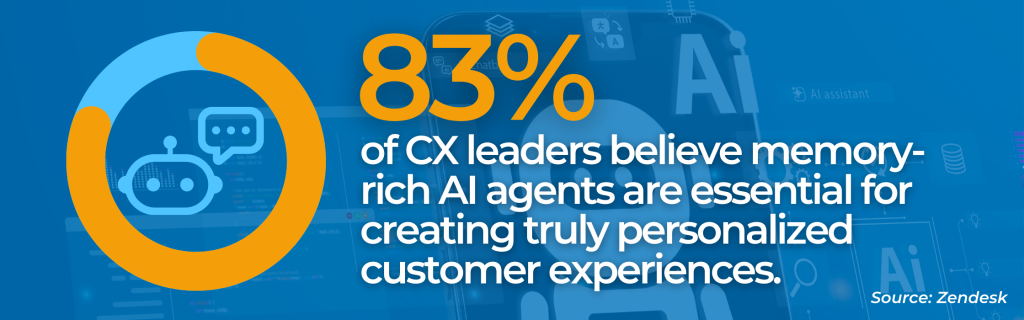
- The Zendesk 2026 CX Trends Report finds that 83% of CX leaders believe memory-rich AI agents are essential for creating truly personalized customer experiences, signaling growing demand for context-aware communications. (Source: zendesk.com)
- Zendesk also reports that customers increasingly expect instant, intelligent, context-aware service, accelerating the need for AI-enabled cloud communications and omnichannel support. (Source: zendesk.com)
- Deloitte predicts the autonomous AI-agent market will reach $8.5 billion in 2026 and grow to $35 billion by 2030, reinforcing that enterprise software—including communications—will rely heavily on AI-driven automation. (Source: deloitte.com)
- Deloitte also notes that 2026 will mark a significant shift as enterprises prepare their systems and workflows for widespread agentic-AI orchestration, laying the groundwork for next-generation cloud communications. (Source: deloitte.com)
- Gartner predicts that by 2028, organizations that leverage multi-agent AI for 80% of customer-facing business processes will dominate their markets, as hybrid AI (AI for routine tasks + humans for complex interactions) becomes the industry standard. (Source: gartner.com)
- Gartner also warns that organizations that fail to adopt multi-agent AI risk losing competitive advantage, as customers increasingly expect low-effort, rapid AI-assisted service and tend to stay loyal to brands that deliver it. (Source: gartner.com)
Together, these projections highlight one apparent reality: cloud communications is entering a new era where AI is no longer an add-on—it is the foundation of future customer interactions, workflows, and business operations.
What’s Fueling the Acceleration of AI Adoption
- AI Has Become More Accurate, Accessible, and Cost-Effective
Generative AI, natural language understanding, and predictive analytics have advanced significantly. Tools that once required specialized teams and large budgets are now accessible to almost any organization. AI is also faster and more reliable, making it suitable for core business operations—not just experimentation.
- Communications Platforms Are Evolving
Modern cloud communication platforms are built on microservices and open APIs, enabling rapid integration of AI capabilities. These flexible architectures make it easier to roll out new AI-driven features without disruption. Businesses no longer need to rebuild their infrastructure to adopt AI—AI can now be layered on top of their existing cloud systems.
- Rising Customer Experience Expectations
Customers expect seamless, personalized, and immediate interactions. Whether communicating through voice, messaging, or video, businesses must deliver consistent, high-quality experiences across every touchpoint. AI helps companies reduce response times, personalize interactions, and maintain service consistency in ways that manual processes cannot match.
- Operational Efficiency and Workforce Productivity
Labor shortages, rising operational costs, and growing service demands mean teams must do more with fewer resources. AI helps automate repetitive tasks, reduce administrative workloads, and give employees more time to focus on higher-value activities. As a result, businesses experience improved productivity, reduced burnout, and better customer experiences.
Practical Ways AI Is Already Enhancing Cloud Communications
AI isn’t coming—it’s already here. The use cases are growing rapidly across both UCaaS and CCaaS.
AI in Cloud Business Communications (UCaaS)
AI is also improving productivity and collaboration across everyday business communications. It enables automated meeting notes, clear voice enhancement, actionable insights derived from call and meeting trends, automated follow-up suggestions, and meaningful reporting across communication channels. The result is better communication hygiene, more informed decision-making, and significantly less manual effort.
AI in Cloud Contact Centers (CCaaS)
Beyond business communications, AI is transforming how modern contact centers operate through intelligent call routing, automated summaries, real-time transcription, sentiment analysis, automated quality assurance, and predictive analytics that anticipate customer needs. These capabilities help contact centers resolve issues faster, reduce operational costs, and deliver more consistent, reliable service.
The Competitive Advantage of Early AI Adoption
Businesses that adopt AI early build momentum that compounds over time. By integrating AI into their communications workflows, organizations gain faster insights, improve decision-making, and unlock higher-quality interactions with customers and internal teams. Workflows that were once bogged down with manual documentation or repetitive tasks become streamlined and more efficient, allowing employees to focus on strategic work that moves the business forward.
Early adopters also benefit from more consistent communication quality, greater accuracy, and the ability to analyze trends previously hidden in calls, chats, and meetings. Over months and years, these incremental efficiencies add up to measurable performance gains. As AI becomes a standard part of business communications, companies that adopt it early will already have systems, culture, and processes aligned with AI-driven operations—making them far more agile than competitors who wait.
The Risks of Delaying AI Integration
Businesses that delay AI adoption in their communications strategy face escalating risks. Competitors who are already leveraging AI gain efficiency advantages that are difficult to match through manual processes alone. Over time, the performance gap widens as AI-enabled organizations move faster, respond more accurately, and deliver more consistent customer experiences.
Delaying AI implementation also leads to higher operating costs, slower decision-making, and difficulties scaling as demand increases. Without AI, businesses miss critical insights hidden within customer interactions and communications data, leaving them at a strategic disadvantage. As AI becomes a baseline expectation rather than a differentiator, late adopters will find it increasingly challenging to catch up.
How Businesses Should Prepare Now
Preparing for an AI-enhanced communications future doesn’t require a complete overhaul—it requires focus, intention, and the willingness to evaluate where AI can have the most significant impact. A good starting point is to assess your current communications tools and identify the areas where manual tasks, inconsistent processes, or limited visibility slow teams down.
From there, organizations should explore cloud communication platforms that are built with AI readiness in mind. This means choosing systems that are evolving rapidly, that offer a clear roadmap for future AI innovation, and that integrate smoothly with existing workflows. Creating a 2025–2026 AI adoption roadmap—one that aligns with broader business goals—helps ensure your organization is prepared for the next wave of transformation.
The most successful companies will be those that engage early, pilot thoughtfully, and embrace AI as a long-term strategic advantage rather than a short-term trend.
The Bottom Line
AI momentum in cloud communications is rising fast, reshaping how organizations connect, collaborate, and serve customers. Businesses that embrace AI now will benefit from greater efficiency, better insights, and stronger customer experiences. At the same time, businesses that delay will struggle to keep up as AI becomes foundational to modern communication systems.
The evolution has already begun. Now is the time to prepare.
Ready to future-proof your communications strategy?
Explore how Crexendo® is helping businesses modernize their communications with flexible, scalable, AI-ready cloud communications solutions. Talk to a Crexendo cloud communications AI expert and get a demo of the AI-powered Crexendo® VIP™ cloud business communications platform today.