For many businesses, the phone is still the front door. It’s where first impressions are formed, questions are answered, and potential customers decide whether to move forward—or move on.
At the same time, answering every call quickly and professionally has become harder than ever. Staffing shortages, higher call volumes, after-hours inquiries, and rising customer expectations have made traditional call handling increasingly difficult to scale. Missed calls and long wait times don’t just frustrate callers—they cost businesses real opportunities.
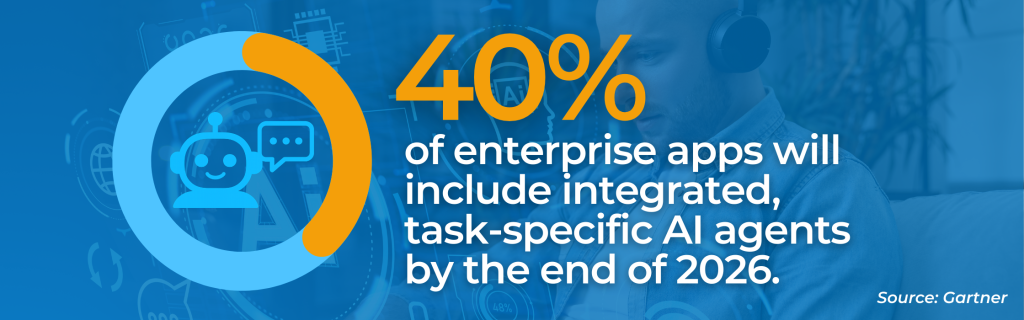
This challenge is unfolding alongside a major shift in how enterprise software is being developed. By the end of 2026, nearly 4 in 10 enterprise applications will include built-in, task-specific AI agents (Gartner). For cloud communications, this means AI is no longer an optional add-on—it’s becoming a native capability. Leading platforms are embedding AI agents directly into call handling, routing, scheduling, and automation, so businesses can rely on intelligent assistance out of the box rather than stitching together disconnected tools.
This is why more organizations are turning to AI receptionists as a smarter, more modern way to manage inbound calls. This blog post answers the question of “What Is an AI Receptionist?” and outlines the business benefits of using one.
What Is an AI Receptionist?
An AI receptionist is a voice-enabled, virtual assistant that answers incoming business calls using natural, conversational language. Rather than forcing callers through rigid phone menus or voicemail prompts, an AI receptionist allows people to speak naturally and be understood.
Using conversational intelligence, the AI identifies the caller’s intent and responds appropriately—whether that means answering a question, routing the call, or helping with scheduling. For businesses, this creates a more efficient and consistent first point of contact.
How Is an AI Receptionist Different From a Traditional Human Receptionist?
Traditional human receptionists play an important role, but their availability and capacity are limited. Coverage is often restricted to business hours, and scaling during peak periods can be costly and difficult.
AI receptionists don’t replace people—they support them. By handling repetitive and high-volume calls, AI receptionists reduce pressure on staff and help ensure callers receive timely assistance, even when teams are busy or unavailable.
What Can an AI Receptionist Do for a Business?
AI receptionists are designed to manage the most common front-desk and call-handling tasks efficiently and consistently. These capabilities focus on improving responsiveness while reducing manual effort.
An AI receptionist can:
- Answer incoming calls using natural, conversational speech
- Provide callers with essential business information such as hours, locations, services, and directions
- Route callers to the correct person, department, or call queue based on intent
- Schedule appointments through conversational interaction
- Deliver a consistent, professional, on-brand experience on every call
By automating these tasks, AI receptionists free teams from repetitive call handling while maintaining a high-quality caller experience.
Why Are Businesses Adopting AI Receptionists
The adoption of AI receptionists is driven by practical business needs, not experimentation. Organizations are facing increasing call volumes while simultaneously dealing with staffing constraints and rising customer expectations.
Callers expect immediate responses, regardless of time or day. Meanwhile, businesses are under pressure to improve efficiency without expanding headcount. AI receptionists help bridge this gap by ensuring calls are handled promptly and intelligently—even when staff availability is limited.
What Are the Key Benefits of Using an AI Receptionist?
More Consistent Call Coverage
AI receptionists help ensure that incoming calls are answered reliably, reducing missed calls and improving responsiveness during busy periods or outside of normal business hours.
A More Intuitive Caller Experience
Instead of navigating phone trees, callers can speak naturally and get what they need faster, resulting in smoother and less frustrating interactions.
Improved Operational Efficiency
By offloading repetitive call handling, AI receptionists reduce interruptions and allow employees to focus on higher-value work that requires human expertise.
Simpler Scalability
As businesses grow, AI receptionists make it easier to handle increased call volume without adding administrative complexity or additional staff.
What Are Common Use Cases for an AI Receptionist?
AI receptionists are commonly used wherever calls are frequent, repetitive, or time-sensitive. Typical scenarios include:
- Main business number coverage
- Front desk and receptionist replacement or support
- Sales call intake and routing
- Service and support call routing
- Appointment-driven businesses
In each case, the goal is the same: respond faster, route more accurately, and reduce manual effort.
Which Industries Benefit Most From AI Receptionists?
AI receptionists deliver value across many sectors where phone communication is essential, including:
- Healthcare and medical offices
- Education institutions
- Nonprofits
- Government and municipalities
- Professional services firms
- Small and mid-sized organizations
These industries benefit from improved responsiveness, reduced administrative workload, and a more consistent caller experience.
How Do AI Receptionists Fit Into Modern Business Communications?
AI receptionists are increasingly becoming a core component of cloud-based business phone systems. They complement UCaaS and contact center environments by:
- Improving call routing accuracy
- Reducing manual call handling
- Enhancing overall customer experience
As communications platforms become more intelligent, AI-driven call handling is quickly becoming the baseline—not the exception.
What Are the Most Common Myths About AI Receptionists?
Despite increased adoption, several misconceptions persist:
“AI receptionists sound robotic.”
Modern conversational AI is designed to sound natural and approachable.
“They’re only for large enterprises.”
AI receptionists are scalable and accessible for organizations of all sizes.
“They can’t handle real conversations.”
Today’s AI understands intent, not just keywords.
“They can’t handle or understand multiple languages.”
Many AI receptionists are designed to support multilingual interactions.
“They’ll replace all human interaction.”
In reality, AI receptionists handle routine calls while humans focus on complex needs.
These misconceptions often stem from outdated assumptions—today’s AI receptionists are purpose-built to enhance real conversations, not replace them.
What Should Businesses Look for in an AI Receptionist Solution?
Selecting the right AI receptionist requires careful evaluation. Businesses should prioritize solutions that are practical, reliable, and easy to manage.
Key considerations include:
- Natural, conversational voice quality
- Simple setup and ongoing configuration
- Seamless integration with your existing phone system
- Accurate call handling and routing
- Flexibility to adapt as business needs evolve
The right solution should enhance communications without adding complexity.
Is an AI Receptionist Right for My Business?
If your organization relies on phone calls to engage customers, prospects, or constituents, an AI receptionist can deliver immediate value. By answering calls, providing information, routing callers intelligently, and supporting appointment scheduling, AI receptionists help businesses stay responsive while operating more efficiently.
For many organizations, adopting an AI receptionist is about modernizing the front door of the business—not replacing the people behind it.
Ready to modernize how your business handles inbound calls?
CAIRO — Crexendo’s AI Receptionist and Orchestrator answers calls naturally, provides callers with accurate business information, routes calls to the right destination, and schedules appointments automatically. It helps businesses improve responsiveness, reduce administrative workload, and deliver a consistent, professional caller experience—without adding staff or operational complexity.
Whether you’re managing growing call volumes or looking to modernize your communications, CAIRO brings intelligent call handling into your cloud communications platform.
Schedule a demo of CAIRO today and see how an AI receptionist can transform the way your business engages callers.