TL;DR: AI-powered contact centers aren’t cutting jobs, they’re changing what those jobs look like. When AI removes friction from customer support, people reach out more often and ask more varied questions, not less, which is why interaction volume keeps rising even as automation grows. Forrester projects a wave of new AI oversight roles as staffing shifts to match. IT and CX leaders should plan for skill shifts and elastic staffing, not layoffs.
In this article:
- Why does AI increase contact volume instead of reducing it?
- How is AI reshaping contact center staffing?
- What skills do contact center agents need now?
- How should leaders measure success in an AI-driven contact center?
- How do you build a team that scales with AI-driven demand?
Introduction
Many IT directors assume AI contact center staffing means fewer people answering phones. The opposite is happening. As AI-powered tools make it faster and easier for customers to get help, those customers contact support more often, not less. This is the same induced-demand effect familiar from other industries: when a service gets easier to use, people use it more.
This pattern already shows up in how customers use AI-powered support: they don’t just accept it, they bring it a wider range of questions than they used to. That volume doesn’t eliminate the need for people. It changes what people do. Routine questions move to AI. Complex, emotional, and high-stakes interactions stay with human agents, who need sharper judgment and better tools than ever.
This post breaks down why interaction volume is rising, how staffing needs are shifting, and what IT and CX leaders should do to prepare for 2026 and beyond.
Why Does AI Increase Contact Volume Instead of Reducing It?
AI contact centers see more interactions because lower friction invites more contact, not less. Customers who once avoided calling now reach out for issues they would have skipped entirely.
When a chatbot resolves a password reset in ten seconds, or a customer routes to the right agent on the first attempt, people stop treating support as a last resort. They ask more questions, more often, because asking finally feels worth the effort.
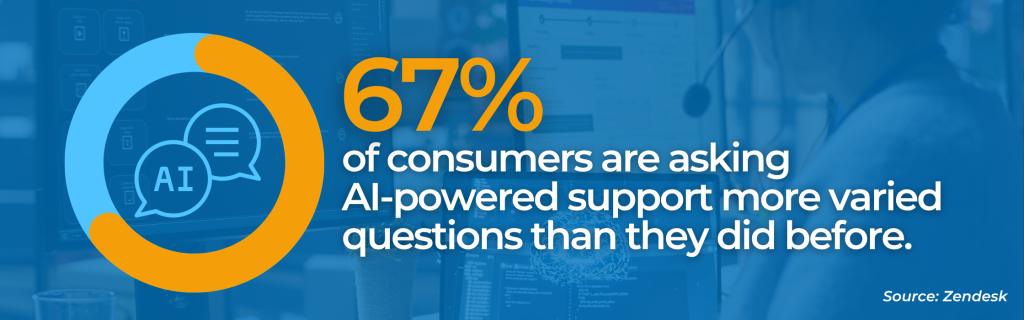
This mirrors a well-documented pattern in technology adoption: making something easier to do increases how often people do it. Contact centers are experiencing this now at scale. Zendesk’s CX Trends research backs this up, finding that 67% of consumers are expanding the range of questions they bring to AI-powered support, asking more varied questions than they did before. Faster service doesn’t shrink demand for support, it multiplies it.
Other analysis of the AI contact center market has pointed to this same Zendesk data as an early signal that automation expands engagement rather than replacing it.
For contact center leaders, this means capacity planning built around shrinking call volumes is already out of date. Organizations preparing their future cloud contact center strategy need infrastructure that flexes with demand spikes, not one sized for last year’s average.
How Is AI Reshaping Contact Center Staffing?
AI is reshaping contact center staffing by shifting hiring away from routine agent roles and toward oversight and specialist positions. Headcount isn’t disappearing, its composition is changing.
Fewer teams need large pools of agents handling simple, repetitive tickets. More teams need people who can manage, train, and troubleshoot the AI systems doing that work. Forrester projects that roughly 30% of enterprises are building parallel AI functions, creating manager, optimization, and specialist roles dedicated to AI performance rather than direct customer contact. The contact center org chart of the future has more roles managing AI than roles it replaced.
This shift shows up first in job postings, not layoff notices. IT and CX leaders should expect budget to move toward AI operations, quality assurance, and workflow design, even as total headcount holds steady or grows. Planning staffing around a platform built for this shift, rather than bolting AI onto a legacy system, makes the transition considerably easier to manage.
What Skills Do Contact Center Agents Need Now?
Contact center agents increasingly need skills AI can’t replicate well: empathy, judgment, and the ability to de-escalate a frustrated customer. As AI absorbs routine tickets, whatever reaches a human agent is, by definition, the interaction AI couldn’t resolve.
That raises the difficulty of every call an agent takes. This changes what good hiring and training look like. Technical troubleshooting skills matter less than they used to. Communication skills, emotional regulation, and the judgment to know when to escalate matter more. The agents who thrive in AI-supported contact centers are the ones AI was never built to replace.
Training programs built around scripts and average handle time no longer prepare agents for this work. Leaders need to invest in coaching for ambiguous, high-emotion situations, and in tools that surface context instantly so agents aren’t starting cold on a complex issue. Modern AI-powered contact center platforms can pull relevant history and sentiment cues into the interaction automatically, before the agent even says hello.
How Should Leaders Measure Success in an AI-Driven Contact Center?
Average handle time and first-call resolution no longer tell the whole story once AI changes what reaches a human agent. Leaders need metrics that capture engagement, effort, and long-term value.
If AI resolves the easy tickets, average handle time will naturally rise for the agents left with harder ones. Treating that as a performance problem misreads what’s actually happening. Leaders need metrics that capture the full picture: customer effort score, engagement frequency, containment rate for AI-handled interactions, and how satisfaction trends over months, not single calls. A metric that made sense when agents handled everything can mislead you once AI handles the easy half.
This doesn’t mean abandoning efficiency measures. It means pairing them with indicators of relationship health. A customer who contacts support five times in a month isn’t necessarily unhappy; they may simply find it easy enough to ask. The goal is separating rising volume from declining satisfaction, and only one of those is a warning sign.
How Do You Build a Team That Scales With AI-Driven Demand?
A cloud-native contact center platform lets teams scale staffing and AI capacity together as demand shifts, instead of guessing at fixed headcount months in advance.
Legacy, on-premises systems make it hard to add capacity quickly or route AI-handled interactions alongside human ones in real time. Cloud platforms solve this with elastic scaling, real-time analytics, and AI features built into the core system rather than layered on top. That combination lets leaders respond to a volume spike in hours, not quarters, and reassign agents toward complex work as AI absorbs routine volume. The right infrastructure turns a staffing challenge into a staffing advantage.
Ready to Build a Contact Center That Scales With AI?
Crexendo’s AI-Powered VIP CX Cloud Contact Center Platform is built for exactly this environment: AI-native routing, real-time reporting, and elastic capacity designed for the demand patterns AI itself is creating. Teams building their contact center roadmap should treat this kind of architecture as a prerequisite, not an upgrade.
AI is changing what your team needs to succeed, not whether it needs to exist. Discover how Crexendo VIP CX gives your agents the tools and context to handle whatever AI can’t. Schedule a free demo today!
Frequently Asked Questions
Will AI reduce contact center staffing in 2026?
Not necessarily. Forrester’s 2026 predictions show enterprises building new AI-oversight roles alongside existing teams, while routine ticket volume shifts to automation. Total headcount often holds steady or grows, even as the mix of roles changes. The bigger shift is in what agents do, not how many there are.
Why does AI increase contact volume instead of decreasing it?
Easier, faster support removes the friction that once stopped people from reaching out. Once customers trust a request will be resolved quickly, they contact support more often for issues they’d previously have ignored. This induced-demand effect is why volume keeps climbing even as automation improves resolution speed.
What skills should contact center agents build for AI-driven environments?
Agents should focus on empathy, judgment, and de-escalation, since AI increasingly handles routine, low-emotion tickets. What reaches a human agent is often the hardest case in the queue. Communication and critical thinking now matter more than scripted troubleshooting steps for day-to-day performance.
How should leaders measure contact center performance when AI changes call mix?
Average handle time and first-call resolution can mislead once AI resolves simple tickets automatically. Leaders should track customer effort score, engagement frequency, and satisfaction trends over time alongside efficiency metrics, separating rising interaction volume from any real decline in customer satisfaction.
What should IT and CX leaders do now to prepare for the rest of 2026 and beyond?
Start by evaluating whether current contact center infrastructure can scale elastically with unpredictable AI-driven demand. Invest in agent training for complex, high-emotion interactions, and adopt metrics that reflect engagement rather than only speed. Cloud-native, AI-ready platforms make this transition considerably easier to manage.