TL;DR: Carriers can now give business customers as little as 90 days’ notice before retiring POTS lines. That’s not enough time to discover, mid-countdown, that your fire panel or fax line still runs on copper. Use the questions below to find out now whether your business has a real POTS line replacement plan or just an assumption that someone else is handling it.
In this article:
- Why is 90 days not enough time to react?
- Do you know which systems still depend on POTS?
- What does “having a plan” actually mean?
- What happens if you wait for the notice?
- How do you build a readiness plan this quarter?
Introduction
Most business leaders already know POTS lines are going away. What fewer can answer is a simpler question: if a disconnect notice landed today, would your business be ready? A POTS line replacement plan isn’t the same as knowing the shutdown is happening. It’s a documented inventory, an owner, a budget, and a target date, built before the countdown starts. With carrier notice windows now as short as 90 days, that distinction matters. This post walks through the questions that separate a business with a real plan from one that’s hoping it never gets tested.
Why is 90 days not enough time to react?
Ninety days sounds workable until the clock actually starts. A 90-day notice window assumes your business starts planning on day one, not day thirty. Porting phone numbers alone can take several weeks once carriers, ports, and provisioning line up. Multi-location businesses need every site scheduled and staffed for cutover, not just one.
Life-safety systems add another layer. Fire panels, alarm monitoring, and elevator phones often require a compliance filing or inspection before a new line goes live, and those bookings fill up fast once a whole wire center is affected at once. Vendor selection, contract review, and equipment shipping each take their own bite out of the calendar.
Add these up and 90 days shrinks quickly. A business that waits for the notice to start its first vendor call is often already behind. That’s the core risk: the window isn’t short because carriers are being unreasonable, it’s short relative to how many separate teams and vendors have to move in sequence. Planning ahead of the notice is the only way to make the timeline realistic instead of a scramble.
Do you know which systems still depend on POTS?
Most businesses underestimate how many systems still run on copper because those systems rarely belong to one team. The biggest risk in a POTS replacement plan is the line nobody remembers exists.
IT typically owns the obvious ones: analog fax machines, modem-based backup connections, and out-of-band management lines. But alarm panels and fire systems are usually managed by facilities or a third-party security vendor. Elevator phones may fall under building management or a leasing company. Point-of-sale backup lines and standalone credit card terminals sometimes trace back to whichever vendor installed them years ago, with no clear internal owner today.
A full POTS inventory means asking facilities, security, IT, and finance the same question: what still runs over a copper line, and who set it up? For background on why this inventory has become urgent across the industry, see our earlier post on the POTS lines shutdown and what businesses need to know. Until that list exists and is current, no replacement plan can be considered complete, no matter how confident IT feels about its own systems.
What does “having a plan” actually mean?
Knowing POTS is being retired is not the same as having a plan to replace it. A real POTS replacement plan has four parts: a current inventory, a named owner per line, a budget path, and a target date that isn’t tied to a notice arriving.
The inventory piece was covered above. The ownership piece matters just as much: every line on that list needs one person accountable for replacing it, not a general awareness that “someone” will handle it when the time comes. Budget approval should happen before a notice creates urgency, since rushed procurement rarely gets the best pricing or the best fit.
The target date is the piece most businesses skip. Setting an internal migration date six to twelve months out, independent of when a notice technically arrives, turns a reactive scramble into a scheduled project. Businesses that treat the notice date as their planning start date are, by definition, starting late. A plan with these four elements in writing is a plan. Anything short of that is an assumption.
What happens if you wait for the notice?
Waiting for the notice to start planning shifts every decision from deliberate to reactive. Reactive migrations under deadline pressure tend to cost more, take longer, and carry more risk than planned ones. Vendor options narrow to whoever can move fastest rather than whoever fits best. Compliance filings for alarm and elevator lines get rushed, raising the odds of a gap in coverage.
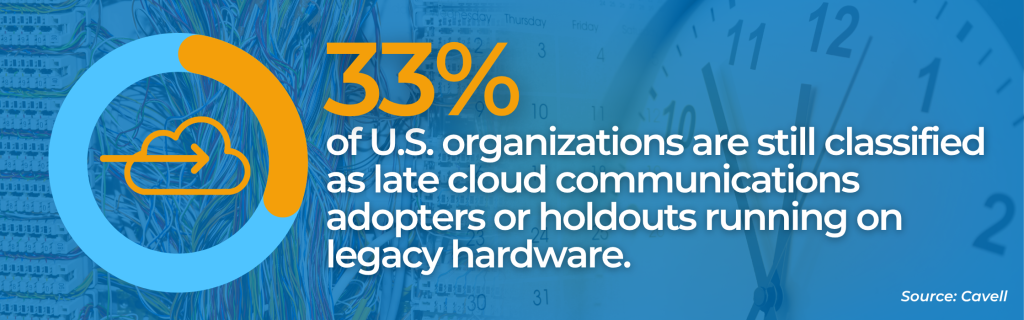
This isn’t a hypothetical risk. Cavell research puts U.S. cloud communications penetration at more than 66%, with roughly 30% to 33% of the U.S. and similar global markets still classified as late adopters or holdouts running on legacy hardware. A notice-driven, reactive migration is exactly the position businesses in that remaining group are likely to find themselves in.
None of this is guaranteed to happen to any single business. But it’s the pattern reactive projects follow, and it’s avoidable. Businesses that treat the move to cloud-based phone systems as a planned upgrade, rather than a forced deadline, tend to end up with better vendor terms, a smoother cutover, and no gap in coverage for critical lines.
How do you build a readiness plan this quarter?
Building a POTS readiness plan doesn’t require a large project team. A workable plan can be built in a single quarter with four concrete steps.
First, complete the inventory within 30 days: pull every account number off carrier bills and confirm with facilities, security, and finance what each line supports. Second, assign an owner to every line on that list, someone accountable for its replacement, not just aware it exists. Third, request timelines and quotes from vendors now, before demand spikes as more notices go out across the industry. Fourth, set an internal cutover date that gives a real buffer before any notice deadline, and treat that date like any other project deadline.
The risk isn’t the migration itself, it’s attempting it without the four steps above already in place. Businesses that treat cloud communications as a planned upgrade, rather than a forced deadline, consistently end up with better vendor terms, a smoother cutover, and no gap in coverage for critical lines.
This is the readiness stage. Once a notice actually arrives, the next questions shift toward immediate response steps, and once a vendor is chosen, the focus moves to the technical details of migrating to cloud communications. Both are worth planning for, but neither replaces the audit above. Readiness starts with knowing what you have and who owns it.
Ready to build your plan?
Crexendo VIP gives businesses a clear path off copper, without the guesswork.
FAQ
How much notice will I get before my POTS line is disconnected? Notice periods vary by carrier and line type, but recent FCC rule changes allow as little as 90 days for many business lines. Check your carrier’s public filings or your account notices directly, since timelines can differ by state and wire center.
What business systems commonly still run on POTS lines? Fax machines, fire and burglar alarm panels, elevator phones, point-of-sale backup connections, and out-of-band modem lines are the most common. These often belong to facilities, security, or finance rather than IT, which is why they’re easy to miss.
Who inside a company should own the POTS replacement plan? Ownership works best as a named individual per line, not a single department. IT can coordinate the overall project, but facilities and security teams typically need to confirm and manage alarm, elevator, and monitoring lines directly.
Is 90 days enough time to replace a POTS line? It can be, if planning starts immediately and vendor timelines are already known. It often isn’t, once porting, compliance filings, and multi-site scheduling are factored in. Starting before a notice arrives removes most of that risk.
What’s the first step in building a POTS readiness plan? Start with a complete inventory: every line, every carrier bill, and every system it supports. Confirm ownership with facilities, security, and finance before assuming IT already knows the full list.
What happens if I don’t replace my POTS line in time? Depending on the line, a missed deadline can mean lost fax or alarm connectivity, a compliance gap on life-safety systems, or a scramble to find same-week vendor availability. None of these outcomes are required if planning starts early.