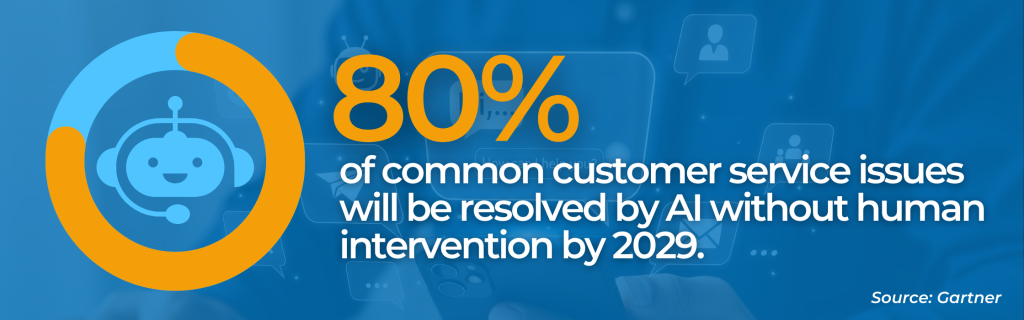
Cloud contact center, also known as Contact Center as a Service (CCaaS), has become the go-to solution for organizations aiming to modernize their customer experience. AI is playing a significant role in the future of customer support – Gartner predicts that by 2029, agentic AI will autonomously resolve 80% of common customer service issues without human intervention. That’s a seismic shift, and it’s forcing businesses to ask an important question: Is our current strategy still future-ready?
While many companies migrated to CCaaS years ago, rapid technological advances in cloud contact center software and rising customer expectations are driving a fresh wave of reassessment. Let’s explore six emerging trends shaping the future and why now is the time to revisit your cloud contact center roadmap.
The Drivers Behind the Re-Evaluation
Several forces are pushing organizations to take a second look at their platforms and strategies:
- Customer Expectations: Consumers demand faster, more personalized, and more seamless service across every channel.
- Technology Acceleration: AI and analytics are advancing at a faster rate than many businesses can keep up with.
- Economic Pressures: Contract renewals, subscription costs, and ROI scrutiny are at the forefront of every CX leader’s agenda.
- Regulatory & Security Demands: With data privacy and cyberattacks on the rise, compliance and resilience are no longer optional.
According to Zendesk, 81% of consumers believe AI has become essential to modern customer service, highlighting the critical importance of adapting technologies that truly deliver.
6 Key Emerging Cloud Contact Center Trends
1. Generative AI and Conversational Automation
We’ve moved beyond basic chatbots. Generative AI is now powering intelligent assistants that summarize conversations, draft responses, suggest next best actions, and even personalize recommendations.
The result? Faster resolution times, reduced agent effort, and improved self-service. However, success depends on more than simply flipping a switch—it requires revisiting your AI roadmap, identifying high-value use cases, and ensuring that data privacy and governance are in place.
Why it matters: Companies that adopt targeted AI use cases can achieve measurable gains in efficiency and customer satisfaction, while those that lag behind risk falling behind their competitors.
2. Omnichannel Becomes Table Stakes
Customers expect to engage with your business on their preferred terms—via voice, chat, email, SMS, or social—and they expect the conversation to flow seamlessly.
Unfortunately, many organizations still operate with siloed systems that require customers to repeat themselves or start over. That’s a recipe for frustration and churn. Businesses are now re-evaluating whether their CCaaS platforms truly deliver unified routing, visibility, and reporting.
Why it matters: Omnichannel is no longer a differentiator—it’s a baseline requirement for delivering consistent, high-quality CX.
3. Data-Driven CX and Advanced Analytics
Analytics used to be backward-looking. Today, advanced platforms deliver real-time insights into customer intent, sentiment, and journey patterns. These tools enable supervisors to coach in the moment and provide agents with data-driven prompts that enhance outcomes.
If your platform can’t tie insights to business results like revenue, retention, or Net Promoter Score, it’s time to rethink. The future belongs to companies that can turn data into action, not just reports.
Why it matters: Data-driven CX enables more intelligent decisions and measurable improvements in both performance and loyalty.
4. Workforce Engagement Management (WEM) in the Cloud
Happy agents create happy customers. That’s why workforce engagement tools—like AI-driven coaching, gamification, and performance dashboards—are becoming central to contact center strategy.
With turnover rates on the rise across the industry, businesses need more effective ways to retain talent, boost employee morale, and provide opportunities for growth. WEM in the cloud delivers the flexibility and intelligence needed to support agents in real time.
Why it matters: Companies that invest in agent experience (AX) not only reduce attrition but also improve CX and efficiency across the board.
5. Security, Compliance, and Resilience
Cybersecurity and compliance have become board-level concerns. As contact centers handle sensitive customer data, leaders must ensure that their platforms meet the highest standards for encryption, zero-trust authentication, and disaster recovery.
AI introduces new risks as well—especially around data retention, model training, and compliance with regulations such as HIPAA or GDPR. Legacy or first-gen CCaaS providers often lack the capabilities to keep up.
Why it matters: A single breach or outage can erode trust overnight. Security and resilience should be a top criterion in every vendor assessment.
6. Flexibility, Scalability, and Vendor Lock-In Concerns
As technology evolves, businesses want to avoid being trapped by inflexible platforms. Open ecosystems, robust APIs, and integration capabilities are becoming increasingly valuable compared to monolithic systems.
Forward-thinking organizations are increasingly building multi-vendor ecosystems, choosing best-of-breed tools while ensuring interoperability. Vendor lock-in is no longer just a pricing issue—it’s a barrier to innovation.
Why it matters: Flexibility ensures your contact center can scale and evolve with your business needs, without costly rip-and-replace cycles.
Implications for Business Strategy
The pace of change in CCaaS means standing still is effectively falling behind. Failing to adapt could lead to higher costs, weaker CX, and customer churn.
On the flip side, embracing these trends opens opportunities to:
- Differentiate through superior experiences.
- Boost efficiency and reduce operating costs.
- Build long-term resilience and scalability.
How to Re-Evaluate Your Contact Center Strategy
Here are five practical steps to guide your reassessment:
- Conduct a Vendor Audit: Review uptime, support, security, and innovation velocity.
- Align with CX and EX Priorities: Balance customer outcomes with agent experience.
- Check Integration Capabilities: Ensure seamless connections with CRM, ERP, UCaaS, and AI tools.
- Evaluate Total Cost of Ownership: Go beyond licensing to include support, training, and hidden costs.
- Future-Proof with Flexibility: Choose platforms that scale and adapt as technology evolves.
The cloud contact center landscape is evolving at a faster pace than ever. Generative AI, omnichannel, analytics, workforce engagement, security, and platform flexibility are no longer “nice-to-haves”—they’re the benchmarks of success. Organizations that proactively re-evaluate their strategy will be best positioned to deliver exceptional customer experiences, reduce costs, and build lasting resilience.
Now is the time to ask: Does your current CCaaS platform prepare you for what’s next—or is it holding you back?
The Solution: Crexendo® VIP™ CX Cloud Contact Center
Crexendo® VIP™ CX was built for this new reality. Backed by 100% uptime guarantees, award-winning support, and AI-driven capabilities, VIP CX empowers businesses to scale with confidence, unify customer interactions, and future-proof their strategy. With Crexendo, you gain the innovation and flexibility needed to keep pace with an ever-changing CX landscape.
👉 Get a Demo of Crexendo VIP CX and see how the right platform can transform your contact center.